
HOW THE AUTOMOTIVE INDUSTRY OUTSOURCED ITS FUTURE—AND CREATED A TECHNICIAN CRISIS
Miller Automotive LLC & TheAutomotiveSite.com
6/3/2026
The automotive service industry in the United States is facing a workforce challenge that is widely acknowledged but often misunderstood. Shops and dealerships across the country report difficulty finding qualified technicians. Service delays are increasing. At the same time, vehicle technology continues to grow more complex, requiring higher levels of skill and specialization.

These challenges are typically framed as a simple labor shortage—a matter of not enough people entering the trade. While that explanation is convenient, it fails to address the deeper structural forces that have shaped the current state of technician training.
At its core, the technician shortage is not merely a pipeline issue. It is the result of a fundamental shift in how the automotive industry has approached workforce development. The industry did not suddenly lose its ability to train technicians; it gradually moved away from that responsibility.
For decades, technicians were developed within the shop environment itself. Entry-level employees were hired with little or no experience and trained through hands-on work, mentorship, and progressive responsibility. This model created a direct link between training and real-world application. Shops invested in people because they depended on them, and technicians developed their skills within the same environments in which they would ultimately perform.
Over time, however, this model eroded. Financial pressures increased. Compensation structures changed. Dealerships consolidated. Cultural expectations shifted. Activities that once represented long-term investment increasingly came to be viewed as short-term cost. At the same time, educational institutions expanded their role in workforce preparation and responsibility for training gradually shifted away from the shop.
This transition was not inherently flawed. Community colleges, technical schools, and manufacturer-sponsored programs provide valuable foundational knowledge and serve as important entry points into the industry. However, these systems were never designed to operate independently. As employer involvement declined, a gap emerged between what educational programs could reasonably deliver and what the workplace required.
The consequences are now evident. The industry faces not only a shortage of technicians, but also a mismatch between skill levels and job demands, high attrition among new entrants, and increasing competition for experienced workers. According to the U.S. Bureau of Labor Statistics, tens of thousands of automotive technician positions open annually, many due to replacement needs rather than new job growth. Meanwhile, organizations such as TechForce Foundation project a need for hundreds of thousands of additional technicians over the coming years.
This article examines how the industry arrived at this point. It traces the evolution of technician training, analyzes the economic and structural forces that shaped it, and explores the limitations of current approaches. It also considers alternative models and identifies principles that may inform future solutions.
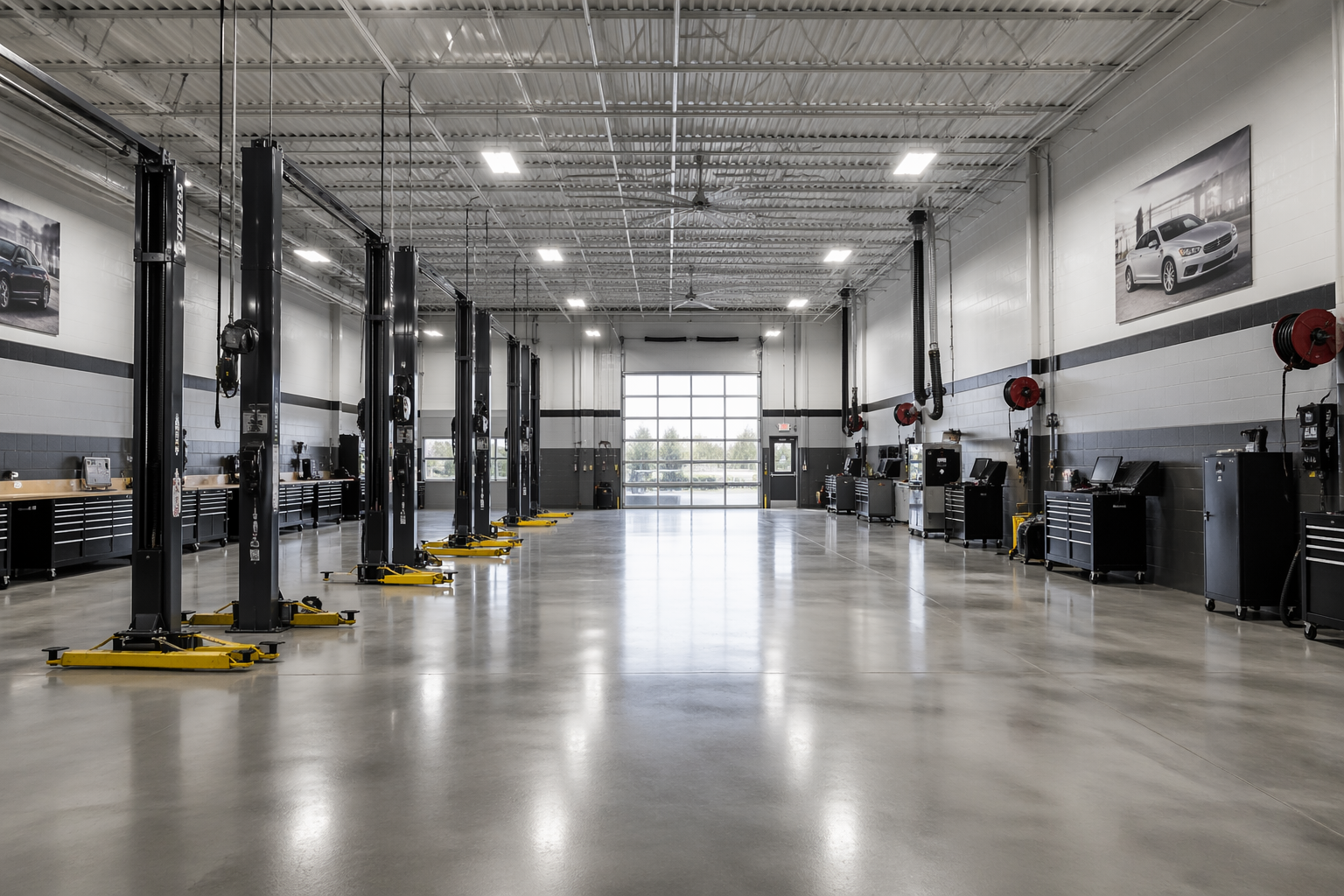
The goal is not to prescribe a single answer, but to reframe the problem. The technician shortage is not simply about attracting more people into the trade. It is about rebuilding a system capable of consistently developing skilled professionals over time.
THE ORIGINAL MODEL: SHOP-BASED TRAINING AND MENTORSHIP
Before the widespread institutionalization of automotive education, technician training was rooted almost entirely within the shop environment. While often informal, this system functioned as a practical apprenticeship model in which inexperienced workers progressed through observation, repetition, and guided instruction.
Entry-level employees—commonly referred to as lube technicians, helpers, or apprentices—were typically hired with minimal prior experience. Their initial responsibilities were simple: oil changes, tire rotations, and inspections. These tasks, however, served as a gateway into a broader learning environment. By working alongside experienced technicians, apprentices were exposed to increasingly complex repairs and diagnostic processes.
Progression was not dictated by a standardized curriculum, but by a combination of shop needs, individual aptitude, and mentorship availability. In high-volume environments, exposure to a wide range of repairs accelerated learning. Over time, apprentices developed into line technicians, and eventually into specialists.
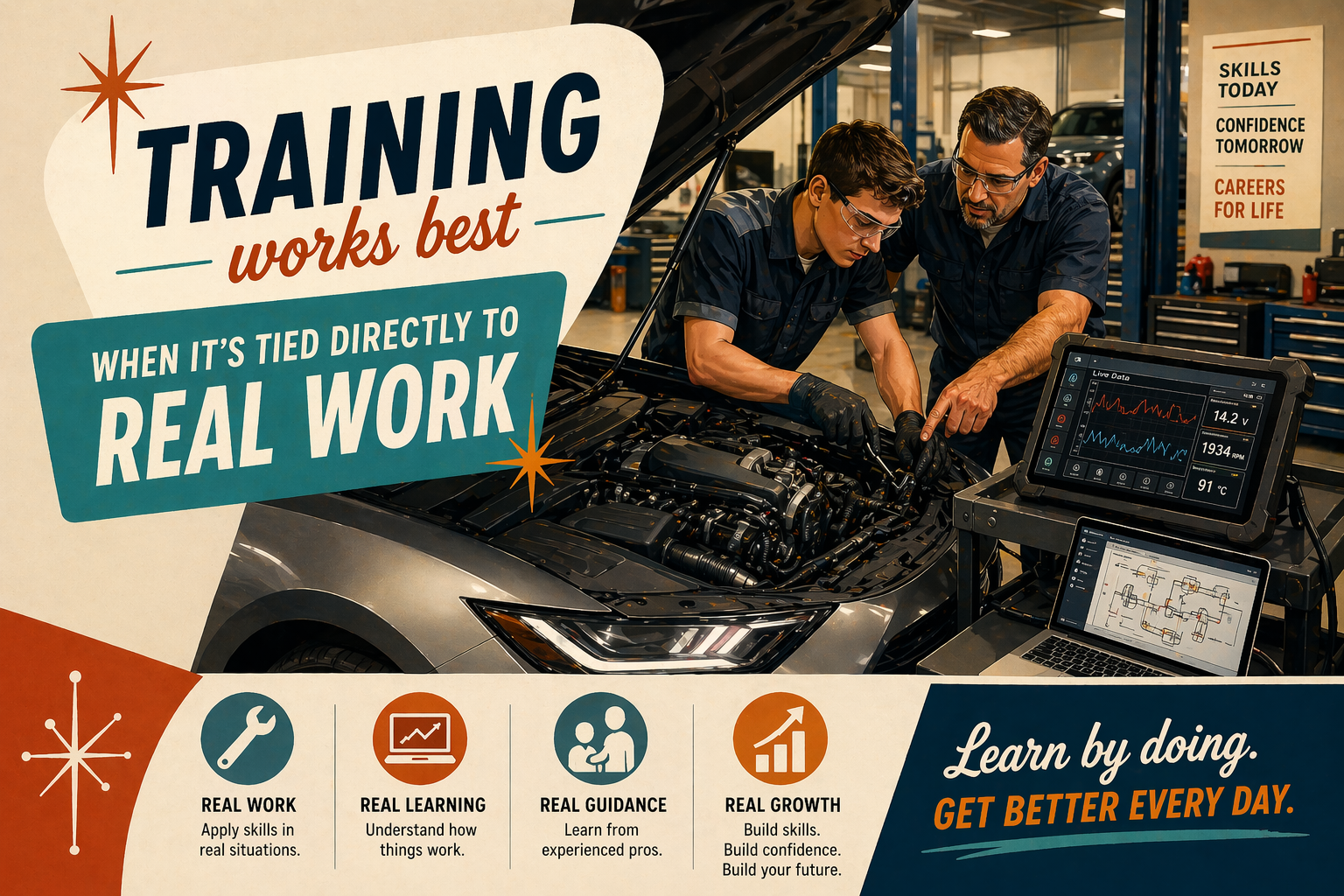
What made this model effective was its integration of learning and production. Training did not occur separately from real work. It was embedded within it. Apprentices learned using the same tools, processes, and time constraints that defined the job. As a result, the transition from trainee to productive technician was often seamless.
The system was supported by aligned incentives. Shops needed skilled labor, and training entry-level workers was one of the most reliable ways to meet that need. While apprentices initially required supervision, they also performed essential tasks that freed experienced technicians to focus on higher-value work. As apprentices developed, they became increasingly productive.
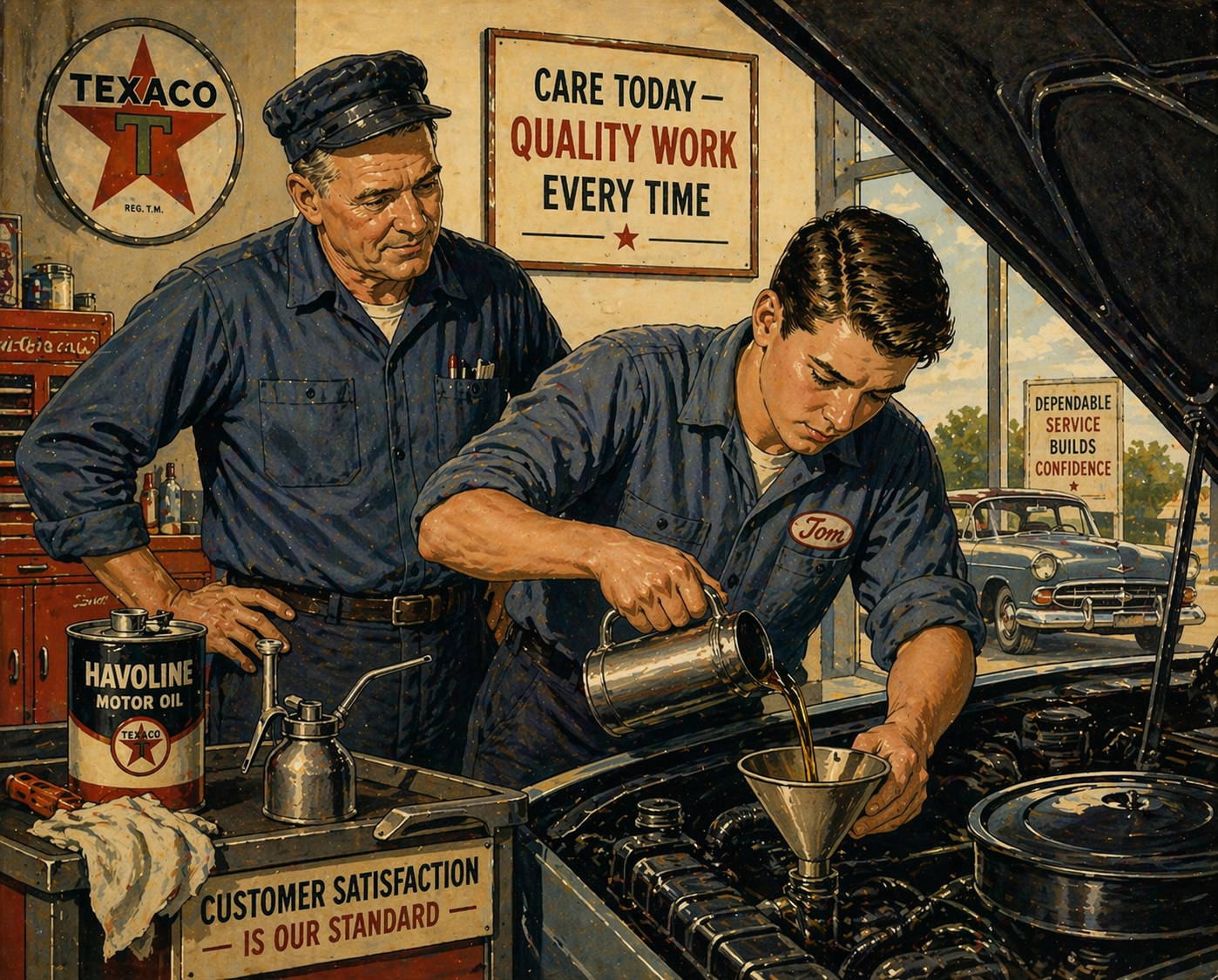
The flat-rate pay system, which compensated technicians based on billed labor hours, further reinforced this structure. Experienced technicians benefited from the assistance of apprentices, while apprentices gained exposure to more advanced work. For employees, the model offered a clear pathway into a skilled trade that did not require significant educational debt and allowed individuals to earn income while learning.
Culturally, shops functioned as both workplaces and training environments. Knowledge transfer was expected. Experienced technicians informally mentored newcomers, passing down skills and problem-solving approaches. Advancement was tied to competence and reliability, creating a merit-based system that rewarded effort and skill development.
Despite its strengths, the model had limitations. Training quality varied widely depending on the shop and the individuals involved. Without standardized curricula or assessments, consistency was difficult to achieve. Additionally, as vehicle technology became more complex, reliance on unstructured, experience-based learning became less sustainable.
Even so, this system produced generations of capable technicians. Its decline was not due to inherent failure, but to broader changes in the economic and organizational structure of the industry.
WHY THE INDUSTRY MOVED AWAY FROM TRAINING
The shift away from shop-based training was not the result of a single decision or event. Rather, it emerged gradually as the industry responded to a series of economic, structural, and cultural pressures.
As dealerships and repair facilities evolved, operational costs increased. Investments in facilities, equipment, insurance, and administrative infrastructure placed growing pressure on profitability. At the same time, service departments became one of the primary profit centers for dealerships, as highlighted in industry reporting from the National Automobile Dealers Association.
Within this environment, efficiency and throughput became central performance metrics. Technician productivity, billed labor hours, and cycle time were closely monitored. Activities that did not directly contribute to revenue, including training were increasingly viewed as costs rather than investments.
The flat-rate compensation system reinforced this shift. While effective at incentivizing productivity, it created structural disincentives for mentorship. Time spent training an apprentice often meant fewer billed hours and reduced income for experienced technicians. For shop management, assigning work to less experienced employees risked slowing operations and impacting customer satisfaction.
At the same time, dealership consolidation introduced new management structures. Large, multi-location dealership groups emphasized standardized processes and short-term financial performance. Training programs, which require localized oversight and long-term investment, were more difficult to justify within these frameworks.
Culturally, the industry began to shift from developing talent to acquiring it. As community colleges, technical schools, and manufacturer-sponsored programs expanded, employers increasingly expected new hires to arrive job-ready. Training was no longer seen as a core function of the shop, but as something that could be outsourced.
This expectation, however, proved unrealistic. Educational institutions could provide foundational knowledge, but they could not replicate the pace, pressure, and variability of real-world shop environments. As a result, many graduates entered the workforce underprepared, while employers lacked the infrastructure, or incentive to bridge the gap.
Risk aversion further compounded the issue. Employers were hesitant to invest in training due to the possibility that employees might leave for higher-paying opportunities. In a competitive labor market, this concern was valid. However, widespread reluctance to train created a self-reinforcing cycle: fewer trained technicians entered the workforce, competition for experienced workers increased, and turnover remained high.
Individually, these decisions were rational. Collectively, they led to a significant reduction in the industry’s capacity to develop its own workforce.
THE RISE OF INSTITUTIONAL TRAINING
As the industry stepped back from internal training, educational institutions stepped forward. Community colleges, for-profit technical schools, and manufacturer-sponsored programs became the primary entry points into the automotive workforce.
Community colleges expanded automotive programs as part of broader efforts to increase access to workforce education. These programs provided foundational knowledge in areas such as engine repair, electrical systems, and diagnostics. They offered relatively affordable tuition and served diverse student populations, often maintaining partnerships with local employers.
At the same time, for-profit technical schools positioned themselves as career-focused alternatives. These institutions emphasized accelerated training, modern facilities, and direct pathways into employment. While they offered structured curricula and faster completion timelines, they also introduced higher tuition costs and, in some cases, inconsistent outcomes.
Manufacturers also developed training programs designed to align education with dealership needs. Programs such as Toyota’s T-TEN and GM’s ASEP combined classroom instruction with dealership-based experience, offering a more integrated approach to training.
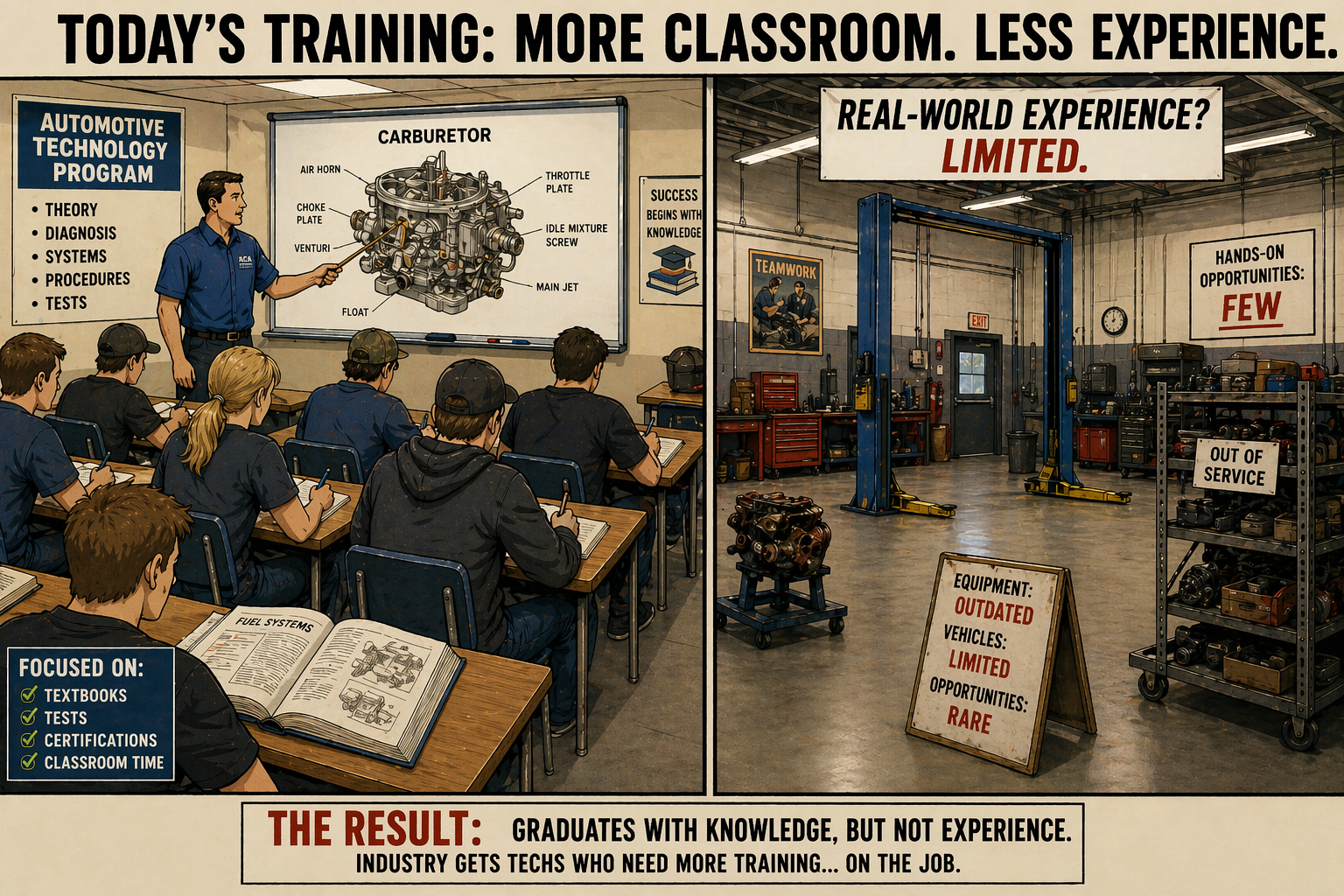
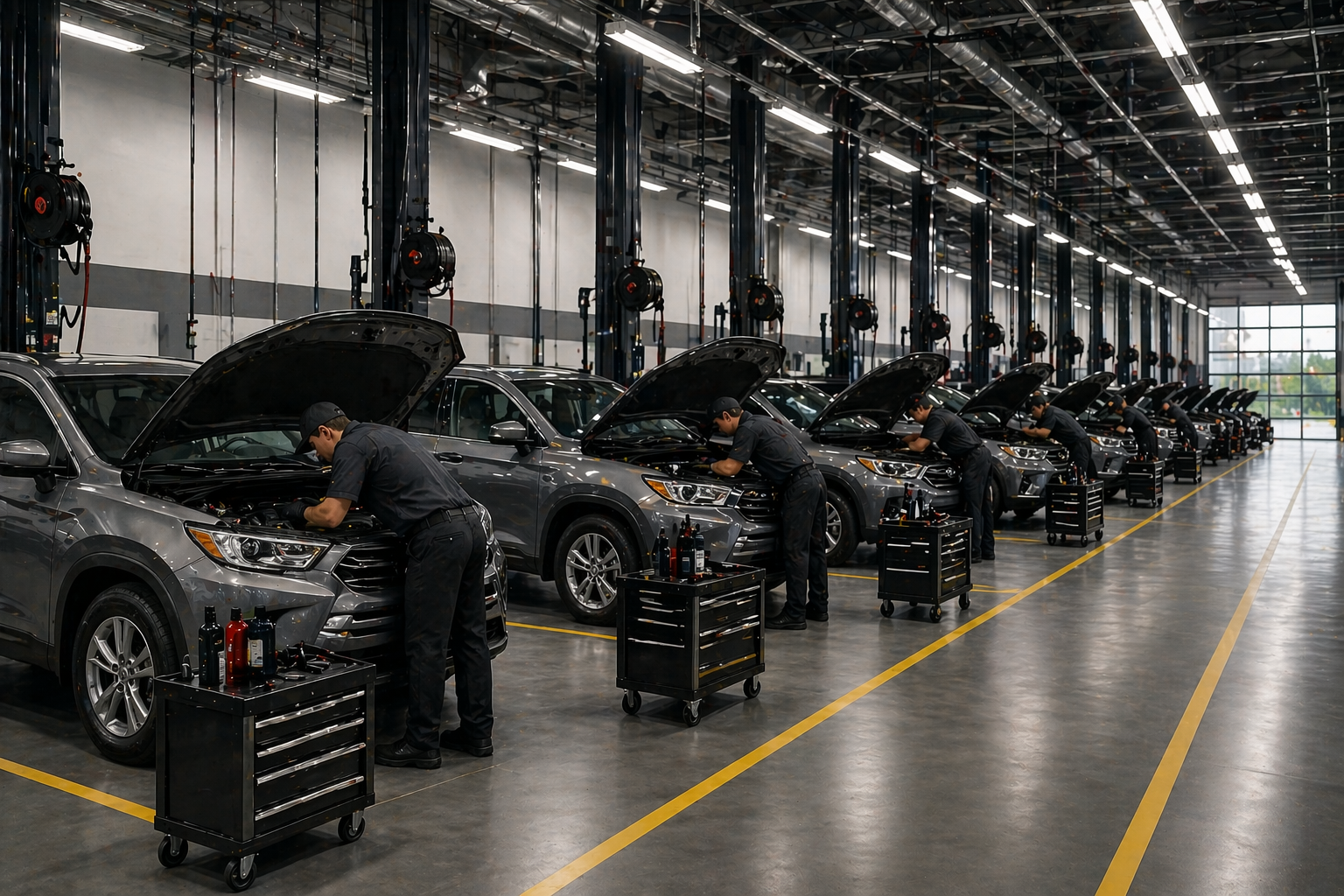
Each of these models contributed value. However, they shared a fundamental limitation: they separated education from production. Students learned in controlled environments that could not fully replicate the realities of a working shop. Even manufacturer programs, while more integrated, were limited in scale and scope.
Additionally, these systems faced challenges related to cost, capacity, and technological change. Automotive systems evolve rapidly, requiring constant updates to curricula and equipment. Expanding programs requires significant investment, and even at full capacity, they struggle to meet industry demand.
The result was a system that provided access to training, but not necessarily alignment with real-world requirements. As employer involvement declined, this gap became increasingly pronounced.
SYSTEM BREAKDOWN: THE MODERN TECHNICIAN SHORTAGE
The cumulative effect of these shifts is the current technician shortage—a structural issue that extends beyond simple supply and demand.
The industry requires a steady influx of new technicians to replace retirees, meet growing demand, and support increasingly complex vehicles. According to the U.S. Bureau of Labor Statistics, tens of thousands of automotive technician positions open each year. The TechForce Foundation estimates that the total need over the coming years could reach into the hundreds of thousands.
Yet the issue is not solely one of quantity. It is also one of readiness. Employers consistently report that graduates lack the practical experience required to perform effectively in production environments. While they may possess theoretical knowledge, many struggle with diagnostics, time management, and real-world problem solving.
Educational institutions face inherent limitations. Capacity constraints, variable completion rates, and the inability to fully replicate shop conditions all contribute to a gap between training and performance. For-profit programs, in particular, may leave students with significant debt relative to entry-level earnings.
Employers, meanwhile, often lack structured onboarding and training systems. This leads to a disconnect in expectations: schools assume employers will complete the training process, while employers expect job-ready technicians. The result is a feedback loop in which both sides perceive the other as falling short.
Attrition compounds the problem. Entry-level technicians frequently leave the industry due to frustration, lack of support, or unclear career pathways. Experienced technicians exit due to burnout or physical demands. The workforce is not only insufficient in size—it is unstable.
The consequences are far-reaching. Labor costs increase as shops compete for experienced technicians. Productivity declines as positions remain unfilled. Existing technicians face increased pressure, further accelerating attrition.
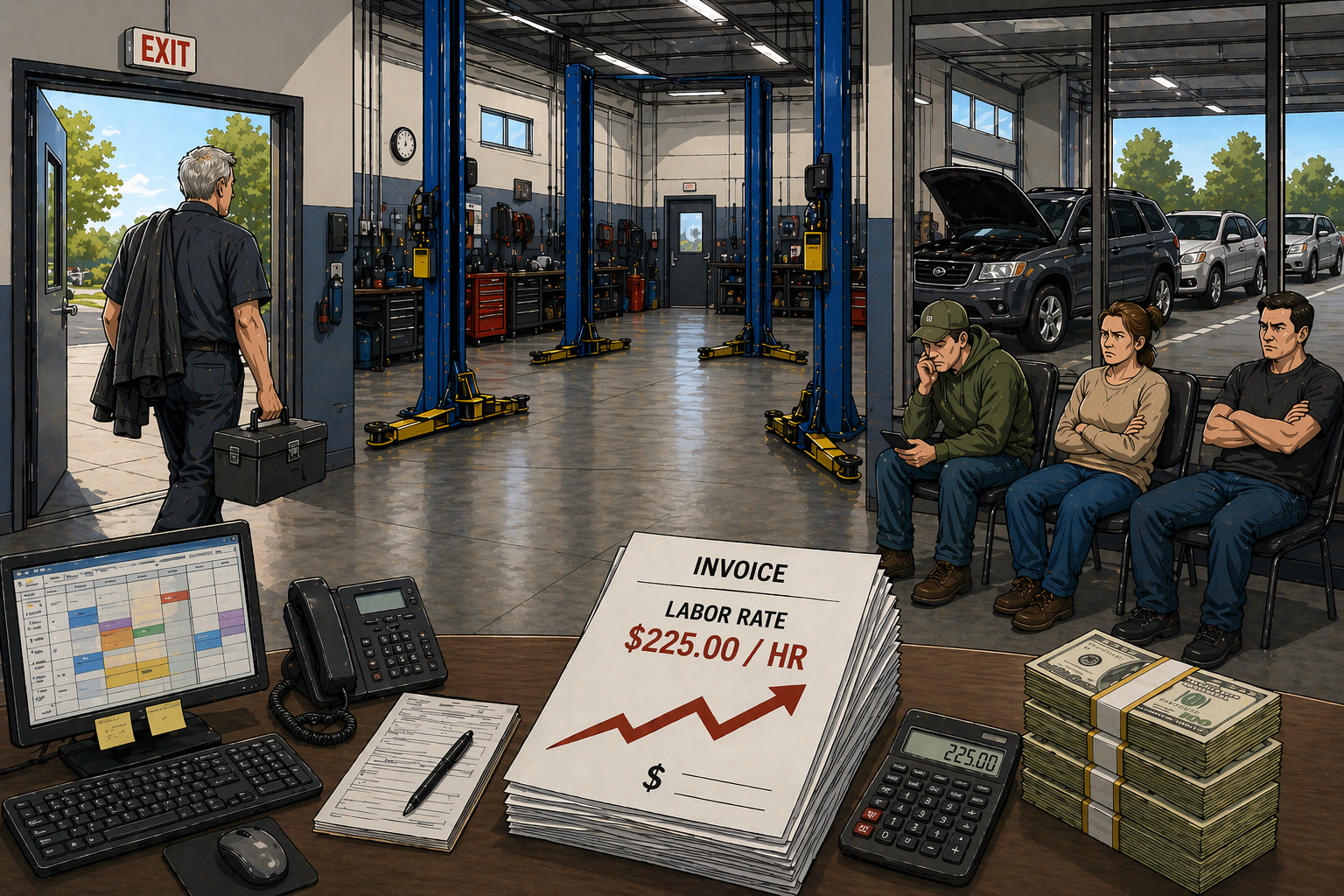
The technician shortage is therefore best understood as a systemic breakdown—one rooted in the misalignment of training, incentives, and industry structure.
COMPARATIVE MODELS: WHAT OTHER SYSTEMS GET RIGHT
The challenges facing the automotive industry are not unique. Other skilled trades and international systems have confronted similar workforce issues and, in many cases, developed more structured and sustainable approaches to training. While these models are not directly transferable, they provide valuable insight into what effective workforce development can look like when incentives, structure, and responsibility are aligned.
Union Apprenticeships in Skilled Trades
In many trades—particularly electrical, plumbing, and pipefitting—training remains deeply integrated with employment through formal apprenticeship systems. These programs combine classroom instruction with paid, on-the-job training over several years, typically progressing through clearly defined stages tied to skill development, wage increases, and certification.
A defining feature of union-supported apprenticeship systems is the alignment of incentives. Employers contribute to training funds, unions ensure standardized skill development, and apprentices earn income while learning. This structure distributes the cost of training across the industry rather than placing the burden on individual employers.
Research from the U.S. Department of Labor and policy analysis from the Urban Institute consistently show that apprenticeship participants experience higher retention, stronger long-term earnings, and faster transitions to full productivity compared to workers entering through traditional hiring pathways.
Importantly, these systems are not built around short-term efficiency. They are designed to produce fully capable professionals over time. Apprentices are not expected to be immediately productive; they are expected to become productive.
The automotive industry has historically resisted unionization, particularly within dealership service departments. Combined with the fragmented nature of the industry, this has limited the adoption of standardized apprenticeship systems. However, the underlying principles—shared investment, structured progression, and integrated learning—remain highly relevant.
International Models: The Dual Education System
Internationally, the most frequently cited model for workforce development is the dual education system used in countries such as Germany. This system integrates vocational education with paid employment, allowing students to split their time between classroom instruction and real-world work.
Unlike the decentralized approach in the United States, dual systems are highly structured and coordinated. Curricula, certifications, and training standards are developed collaboratively by industry, educational institutions, and government bodies. This ensures that training remains aligned with labor market needs.
One of the most significant advantages of the dual system is cultural. Vocational training is widely respected and considered a viable alternative to academic education. This broad acceptance increases participation and reduces the stigma often associated with trade careers in the United States.
For employers, the system provides a reliable pipeline of workers who are already familiar with workplace expectations and processes. For students, it offers a clear pathway into stable, skilled employment without significant educational debt.
While replicating such a system in the United States would be challenging due to structural and cultural differences, the core principles—early integration of work and education, shared responsibility, and standardized outcomes—offer valuable guidance.
Manufacturer-Led Training Models
Within the automotive industry itself, manufacturer-sponsored programs provide examples of more integrated training approaches. Programs such as Toyota’s T-TEN and GM’s ASEP combine formal instruction with dealership-based experience, allowing students to develop skills in real-world environments while still in training.
These programs demonstrate the benefits of alignment. Students learn systems, tools, and processes that are directly relevant to their future employment. Dealerships gain access to trainees early, reducing hiring risk and shortening onboarding time.
However, these programs remain limited in scale. Participation is restricted by geography, manufacturer affiliation, and program capacity. While effective for those involved, they do not significantly alter the overall workforce pipeline.
Even so, they illustrate an important point: when training is closely integrated with employment, outcomes improve.
Across these different models, a few consistent themes stand out. Training tends to be most effective when it is tied directly to real work, not separated from it. Responsibility is shared across employers, educators, and the trainees themselves, rather than pushed onto a single part of the system. Progression is clearly defined, with structured steps that build skills over time. Perhaps most importantly, these systems are built on long-term investment, not short-term productivity.
That stands in sharp contrast to the current automotive model. Today, much of the responsibility for training sits outside the shop, with heavy reliance on external education and loosely structured on-the-job learning. The result is a disconnect—one system designed around coordination and development, the other around immediate need. The gap between the two highlights the opportunity, and the necessity, for a more aligned and deliberate approach to building the technician workforce.
Any discussion of technician training must account for the realities of the modern shop environment. Regardless of theoretical models or external systems, training ultimately occurs—or fails to occur—within the context of daily operations.
Today’s shops are not designed as training environments. They are designed as production systems.
Modern service departments operate under constant pressure to produce. Revenue is generated through billed labor hours, and nearly every aspect of performance is measured against efficiency and throughput.
Technicians are assigned work based on their ability to complete it quickly and correctly. Delays impact revenue, customer satisfaction, and operational flow. Within this environment, time is the most valuable resource.
Training, by its nature, consumes time. Assigning work to less experienced technicians slows production. Providing mentorship reduces the productivity of experienced technicians. Even when there is willingness to train, there is rarely time to do so effectively.
This creates a fundamental tension between short-term productivity and long-term workforce development.
The complexity of modern vehicles has increased dramatically. Advanced electronics, software-driven systems, and electrified powertrains require a higher level of technical knowledge than ever before.
Technicians are expected to interpret data, diagnose complex systems, and adapt to rapidly evolving technologies. This increases the importance of training—but also raises the barrier to entry.
Entry-level technicians often struggle to contribute meaningfully in early stages because even basic tasks may require specialized knowledge. Meanwhile, experienced technicians must continually update their skills, often without structured support.
Training is no longer optional—it is essential. Yet the system is not designed to support it.
The flat-rate compensation system reinforces these challenges. Technicians are paid based on billed hours, not time spent. This incentivizes efficiency but discourages non-billable activities such as training.
For experienced technicians, mentoring represents lost income. For new technicians, slow completion times result in lower earnings. The system creates pressure at both ends of the experience spectrum.
Without deliberate adjustments, the flat-rate model prioritizes production over development.
The automotive service industry is highly fragmented. Dealerships, independent shops, and national chains operate under different models, with varying resources and approaches to training. This decentralized structure makes it difficult to implement consistent, large-scale solutions. While voluntary frameworks such as those created by the ASE Education Foundation establish recognized standards for training programs, participation is not universal, and alignment between education and employment remains inconsistent across the industry. This results in inconsistent outcomes. Some shops invest heavily in development, while others rely entirely on external hiring. For new technicians, experiences vary widely depending on where they enter the industry. These dynamics have produced a training gap that is both pervasive and structurally difficult to address.
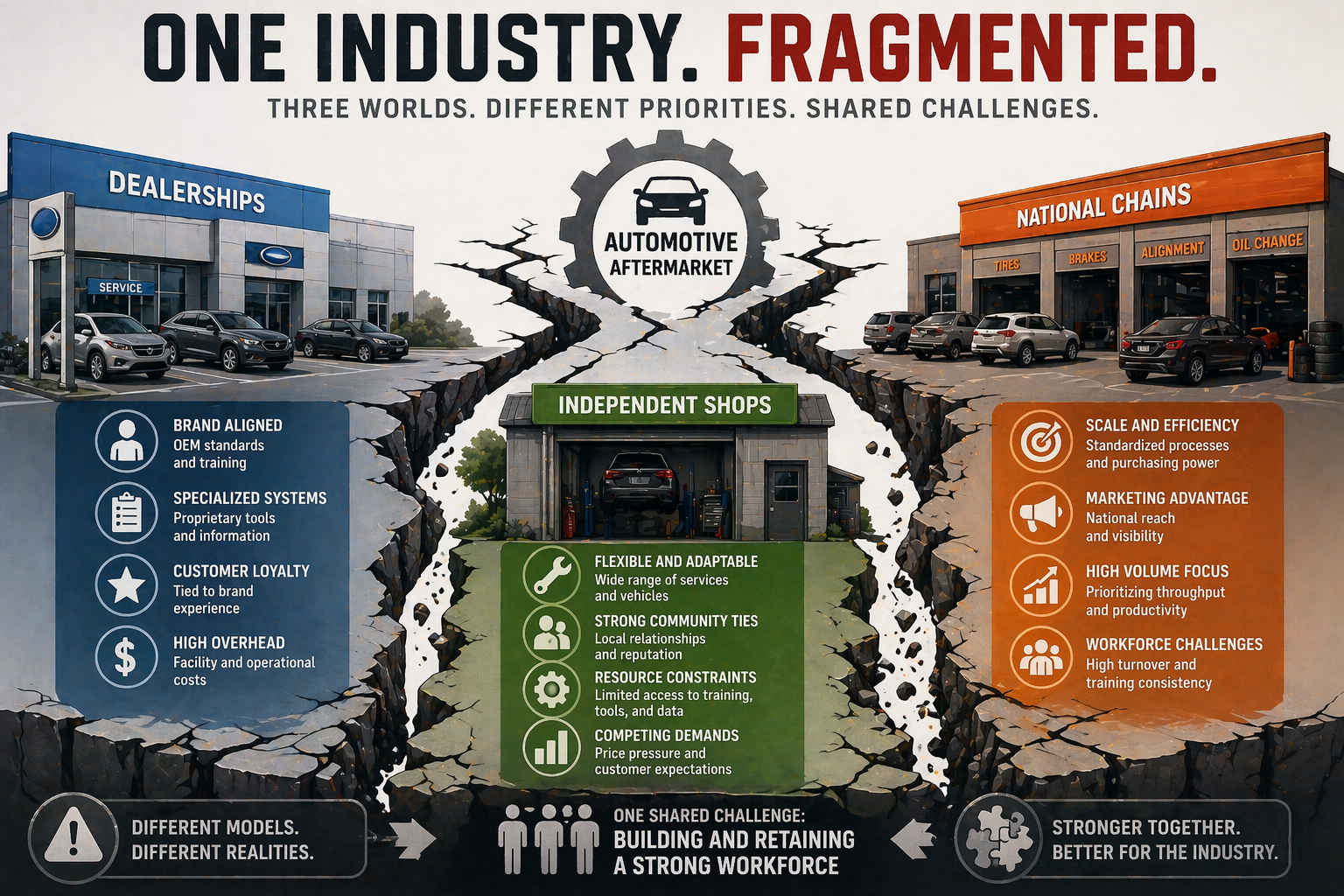
In practice, this gap manifests in several ways. Entry-level technicians have limited exposure to advanced diagnostic work. Experienced technicians operate under constraints that leave little room for mentorship. Shops prioritize immediate productivity, often at the expense of long-term development. As a result, new hires frequently struggle to transition from academic preparation to real-world performance. The limitation is not a lack of capability, but a lack of structural support for training within the system itself. Addressing the technician shortage requires more than increasing enrollment in educational programs. It requires rethinking how training is integrated into the industry itself.
Reframing the Employer’s Role
Historically, shops were central to workforce development. Re-engaging employers in training does not mean returning to informal systems, but it does require recognizing training as a core function rather than an external responsibility.
Employers are uniquely positioned to provide real-world experience, reinforce practical skills, and shape professional expectations. Without their involvement, training remains incomplete.
Hybrid Training Approaches
A more practical path forward may lie in hybrid training models—approaches that bring education and industry back into alignment instead of treating them as separate systems. In these models, schools focus on what they do best: building foundational knowledge, introducing core concepts, and creating a structured learning environment. Shops, in turn, provide what classrooms cannot—real-world application, pace, and context. The responsibility for developing a technician doesn’t sit entirely on one side or the other; it’s shared.
In practice, this can take several forms. Work-study programs, structured apprenticeships, and partnerships between schools and local employers all move in this direction. The specifics may vary, but the underlying idea is consistent: learning and working happen in parallel, not in sequence. When these systems are aligned—when expectations are clear and both sides are actively involved—the transition from student to technician becomes far less disruptive. Instead of stepping into a completely unfamiliar environment, new hires enter the workforce with experience that already reflects the realities of the job.
Structured Mentorship and Progression
Modern training requires structure. Clearly defined skill levels, documented competencies, and intentional mentorship can improve consistency and scalability.
Equally important is supporting mentors. Without adjustments to compensation or workload, mentorship will remain limited regardless of intent.
Training does not happen by accident—it follows incentives. In environments where productivity is measured, rewarded, and closely tracked, while training is treated as secondary or even disruptive, development naturally falls off. Technicians focus on what they are paid to do, and shops prioritize what keeps revenue moving. Without intentional alignment, training becomes something that is talked about, but rarely built into the daily operation.
Addressing this doesn’t require a single universal solution, but it does require deliberate alignment. That can take the form of protected training time, incentives for experienced technicians to mentor, or performance metrics that recognize development alongside production. The specific approach may vary by shop or organization, but the principle remains the same: if training is expected to happen, it has to be supported—and rewarded—by the system around it.
Expanding Entry Points
The industry will also need to rethink how it brings new people in. Relying primarily on post-secondary programs limits both the size and diversity of the talent pool. Those pathways matter, but they represent only one entry point into the profession. If the goal is to meaningfully expand the workforce, recruitment has to extend beyond traditional channels.
That means building alternative on-ramps—stronger partnerships with high schools, programs designed for career changers, and clearly defined entry-level roles that include structured development. The shift is as much philosophical as it is practical. Instead of expecting candidates to arrive fully formed, the industry has to return to the idea of developing technicians over time, building capability rather than simply trying to buy it.
Retention as a Strategy
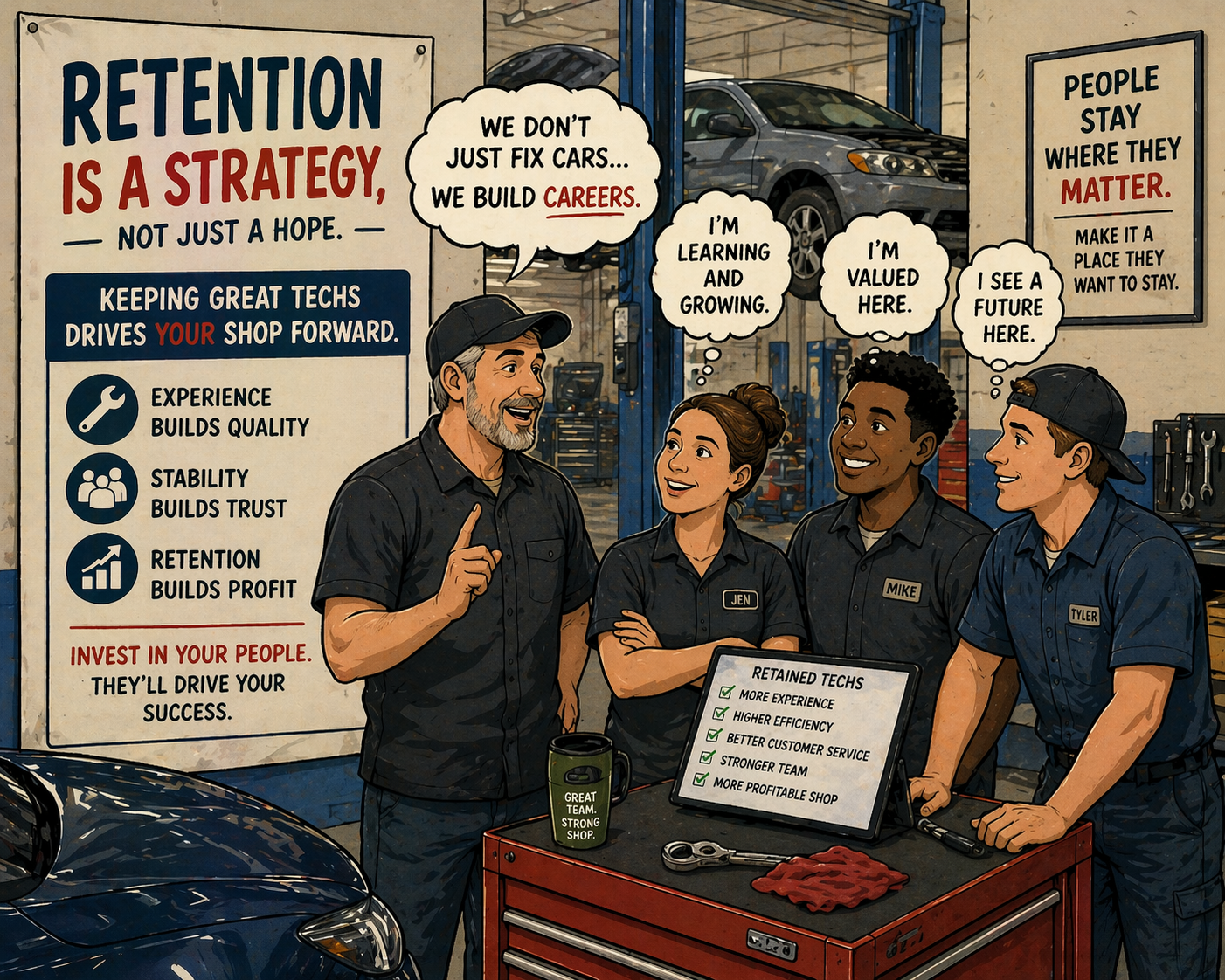
Retention matters just as much as recruitment—arguably more. Bringing new people into the industry only solves part of the problem. If those individuals don’t see a future for themselves, they won’t stay. Too often, new technicians enter the field with enthusiasm, only to encounter unclear expectations, inconsistent pay structures, or environments that prioritize output over development. When that happens, the industry doesn’t just lose employees—it loses the time and resources already invested in them.
What’s often missing is a visible path forward. Technicians need to understand how they progress from entry-level roles to higher-skill, higher-compensation positions. That progression should be tied to measurable skill development, not just time served or production alone. Clear milestones, access to training, and opportunities to specialize can make the difference between someone viewing the role as a short-term job versus a long-term career.
A sustainable workforce depends on more than getting people in the door. It requires keeping them engaged, supported, and moving forward. Recruitment fills the pipeline, but retention builds the profession.
A Flexible Framework
There is no single solution that will work for every shop. The automotive service industry is too diverse—spanning independent operations, dealership groups, and everything in between—for a one-size-fits-all model to be effective. What does translate across all of these environments, however, are a set of underlying principles that consistently show up in systems that work.
Training has to be connected to real work, not separated from it. Responsibility for developing technicians cannot sit with schools alone; it has to be shared across the industry. Skill development needs to follow a clear, structured path so that progression is visible and attainable. And just as importantly, incentives have to support that development. If the system rewards production but ignores training, training will always fall behind.
The goal isn’t to return to an earlier era or replicate the past exactly. The industry has changed, and so have the demands placed on technicians. But what must be rebuilt is the connection between training and production—the idea that learning is not something that happens before the job, but as part of it.
Data
1. U.S. Department of Labor – Apprenticeship Outcomes
Key Data Points:
~91% employment after completion
Higher wages vs non-apprentices
Positive employer ROI
Source:
U.S. Department of Labor ApprenticeshipUSA
Apprenticeship Fact Sheet / Impact:
Supporting Report:
“The Benefits and Costs of Apprenticeships”
2. Urban Institute – Apprenticeship Research
Key Findings:
Higher long-term earnings
Lower turnover
Faster transition to productivity
Source:
Urban Institute
Main Apprenticeship Research Hub:
https://www.urban.org/policy-centers/center-labor-human-services-and-population/projects/apprenticeship
Key Report:
“Expanding Apprenticeship in the United States”
3. Community College Research Center (CCRC)
Key Findings:
Employer-connected programs outperform classroom-only programs
Better completion + job alignment
Source:
Community College Research Center
Relevant Reports:
Work-Based Learning Overview:
“Aligning College and Career Pathways”
4. OECD – International Dual Education Systems
Key Findings:
Lower youth unemployment
Strong school-to-work transition
High employer satisfaction
Source:
Key Reports:
“Apprenticeship in England, UK, and International Comparisons”
“Learning for Jobs”
5. Automotive-Specific Data – TechForce Foundation
Key Findings:
Technician shortage projections (700k–800k)
Pipeline leakage
Employer complaints about job readiness
Source:
TechForce Foundation
Key Reports:
Technician Supply & Demand Report:
Student Retention + Pipeline Insights:
6. U.S. Bureau of Labor Statistics (BLS)
Key Data:
Annual job openings
Replacement vs growth demand
Source:
U.S. Bureau of Labor Statistics
Automotive Technician Page:
7. ASE Education Foundation
Key Insight:
Establishes standards
Improves consistency
Does NOT guarantee job readiness
Source:
ASE Education Foundation
Program Standards:
8. Additional Supporting Research
Harvard / ROI of Apprenticeships
“The Benefits and Costs of Apprenticeship” (Mathematica / DOL-backed)
Brookings Institution